
Lake County Bench Warrants Explained
A Lake County bench warrant comes from the judge already handling a case, not from a new accusation. It usually means a required step did not happen. Minnesota's rules list the common triggers: a missed court date, no answer to a summons or citation, or a violation of a release condition. Probation and supervision problems can travel the same path. Once signed, the order lets any peace officer bring the person in. It is the court asking to see someone, nothing more.
When Lake County Issues a Warrant
A missed date does not automatically produce a warrant in Lake County. Under Minnesota's criminal rules, a prosecutor, court services officer, or probation officer may apply for either a summons or a warrant. A summons is generally preferred. The choice turns on practical risk factors: whether the person would likely respond, whether there is a safety concern, and whether the location is known. A court issuing a summons is still acting on the missed obligation. Note: from outside the file, a missed date that produced a summons and one that produced a bench warrant can look exactly the same in Lake County.
How Lake County Bench Warrants Are Issued
Someone applies, and a judge decides. In Lake County that happens at the District Court in Two Harbors, which handles the county's criminal and traffic cases. Court Administration keeps the file and the calendar, so the same office that answers a copy request can tell you what the case says today. The order itself is short. It carries a signature, a date, and authority for a peace officer to arrest the person named and bring them promptly before the court. The Sixth District covers Lake, Carlton, Cook, and St. Louis counties. Its administrative office oversees all four but hears no cases.
The Lake County Bench Warrant Form
Minnesota Rule 4 Form 8 is the state's model for this exact situation. It is an application and warrant for a defendant's appearance after a failure to respond to a summons or citation. The form states that probable cause was established earlier, orders any peace officer to arrest the person, and directs a prompt appearance before the court. Reading it shows what a Lake County judge actually signs. The blank failure-to-appear warrant form is public.
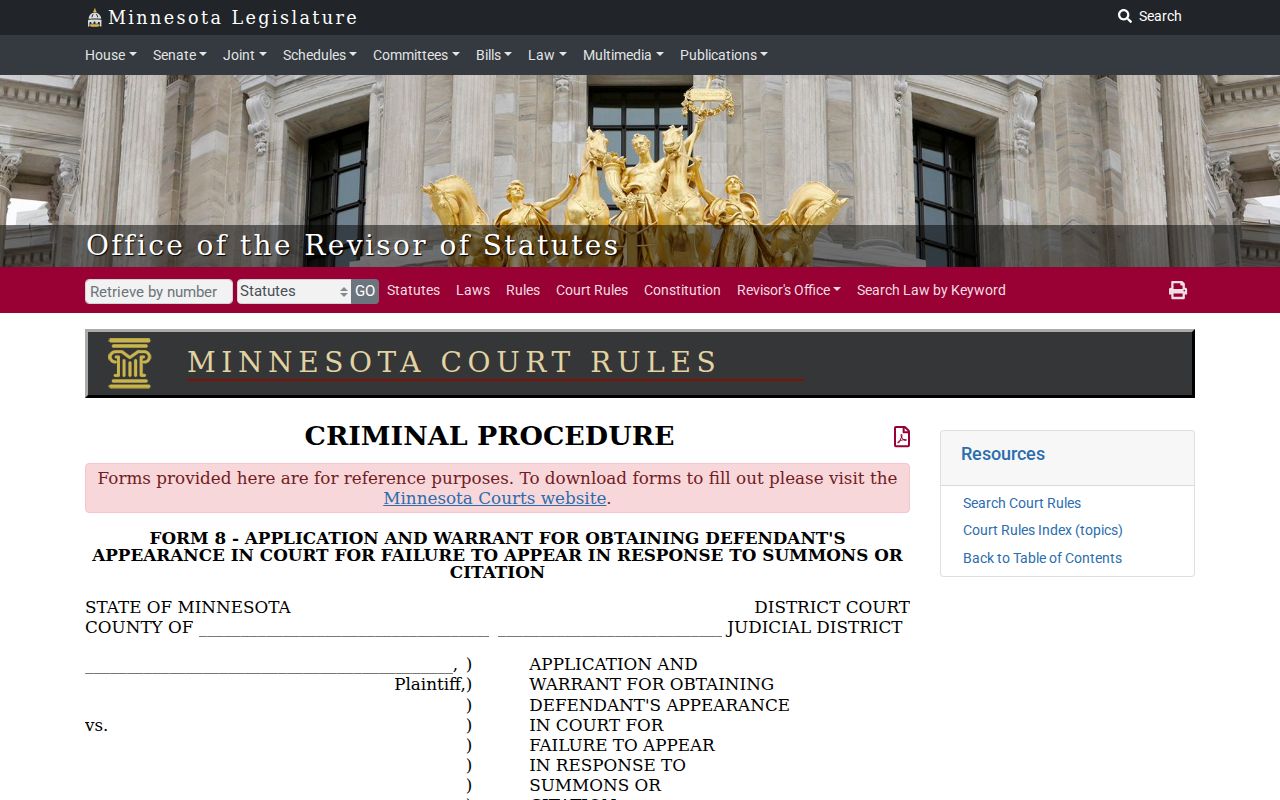
Read it as a model of the process only, not as a record about any person in Lake County.
Bench Warrants and Arrest Warrants Compared
People use the two terms interchangeably, but they mark different moments. An arrest warrant follows a charging decision. A bench warrant in Lake County follows a failure to do something the court already required.
| Point | Bench warrant | Arrest warrant |
|---|---|---|
| What starts it | A missed appearance or broken condition | A complaint supported by probable cause |
| Who asks | Prosecutor, court services, or probation | Prosecutor, with a charging document |
| Usual first response | A summons, unless risk factors support a warrant | A warrant or a summons, at the court's discretion |
| What it means | The court wants the person in front of a judge | The court authorizes custody on a new case |
Missed Court and Lake County Bench Warrants
Missing a date happens often in Lake County. Silence is the worst response, and showing up unprepared runs a close second. Start with the case file and a phone call.
- Find the case number in the statewide case search or on your paperwork.
- Read the last entries to see whether the court issued anything after the missed date.
- Call Court Administration and ask what the case requires next.
- Call a lawyer before you agree to a date or an appearance.
- Follow whatever the court orders, and keep proof of anything you complete.
Resolving a Lake County Bench Warrant
No single transaction clears a Lake County bench warrant, and no office takes a payment to make one vanish. The court can recall or quash the order after an appearance, an allowed motion, or proof that the missing condition was met. It can also set bail or release terms and a new date.
Call before you appear. Walking into a courthouse with an open bench warrant can end in custody, so confirm the process and get legal advice first.
Cash bail may be posted at the Lake County jail at any hour. The jail takes no personal checks or cards for that purpose. No walk-in surrender schedule and no bench warrant filing fee are published, so ask before traveling. Note: Paying a fine alone does not recall a warrant.
Lake County Traffic Warrants Are Not Automatic
Minnesota keeps petty and payable traffic failures separate from felony cases. Statewide court policy gives the local court several responses to a missed payment or date in a Lake County traffic matter: a notice, an arraignment, a bench warrant, a referral for a complaint, or nothing at all. A missed deadline is a real problem without guaranteeing a warrant. The statute is Minnesota Statutes section 169.92, and Rule 6 adds the failure-to-appear framework.
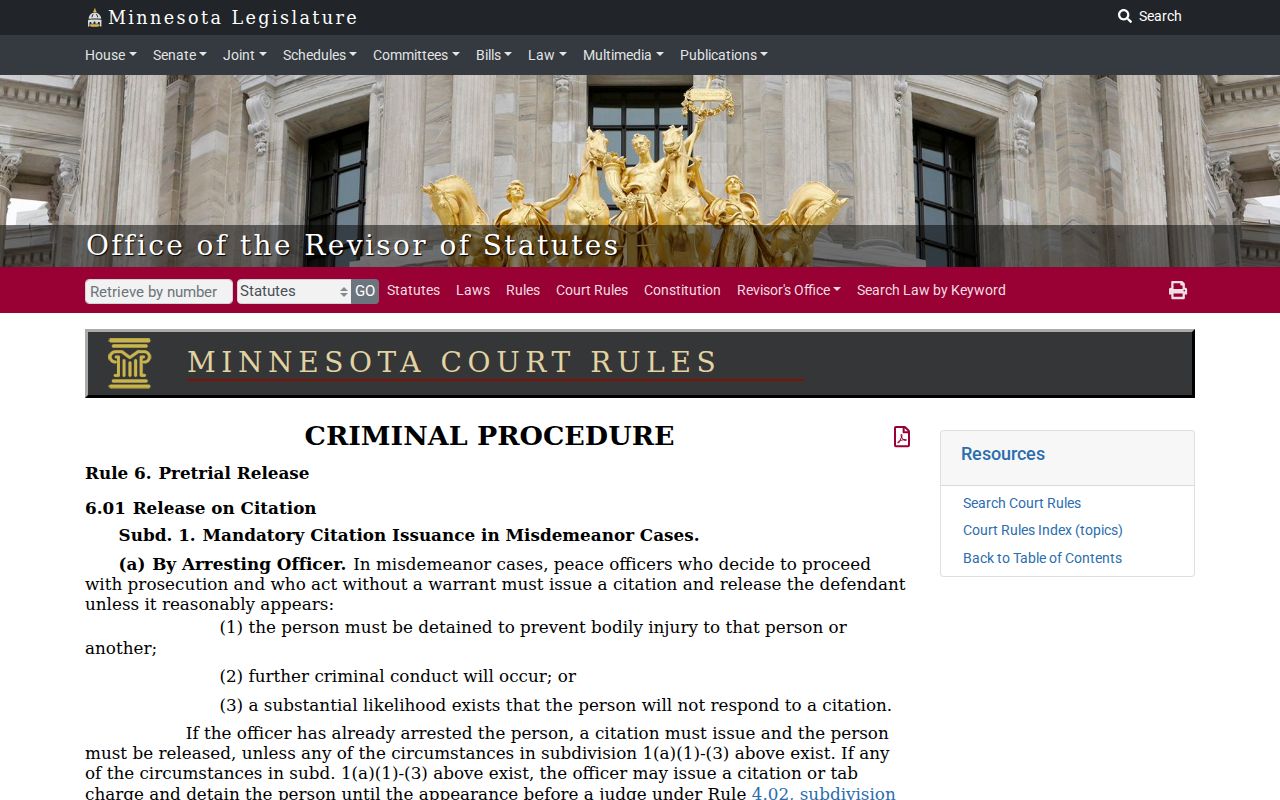
The same policy guides the court's choices in any Lake County traffic matter. The outcome depends on the individual case.
Finding the Court That Issued the Warrant
Only the court that issued a bench warrant can recall or quash it, so that is where any Lake County warrant check should begin. Most matters here land in District Court at 601 Third Avenue in Two Harbors. Its hours and phone number are published on the Lake County court page. Some people look for a local municipal court first. There is none in this county. City police can still make arrests and write citations, but the case that follows is filed in district court. A warrant from another county works the same way. The court that issued it keeps control, and a Lake County clerk cannot recall it.
Lake County Bench Warrant Record Entries
Minnesota sorts its law-enforcement records by classification rather than swinging between full disclosure and total closure. Most arrest-response data is open to the public. That includes the time, the place, and the legal basis for an arrest, while active investigative material stays protected. Court files play by the judicial branch's own access rules, and some warrant paperwork cannot be pulled remotely at all. A Lake County reader browsing a case online may see that a warrant event happened without ever seeing the document behind it. When something is missing, ask the records office what was withheld and under which classification instead of guessing from the gap. The framework itself comes from Minnesota Statutes section 13.82, which lays out how these classifications work.
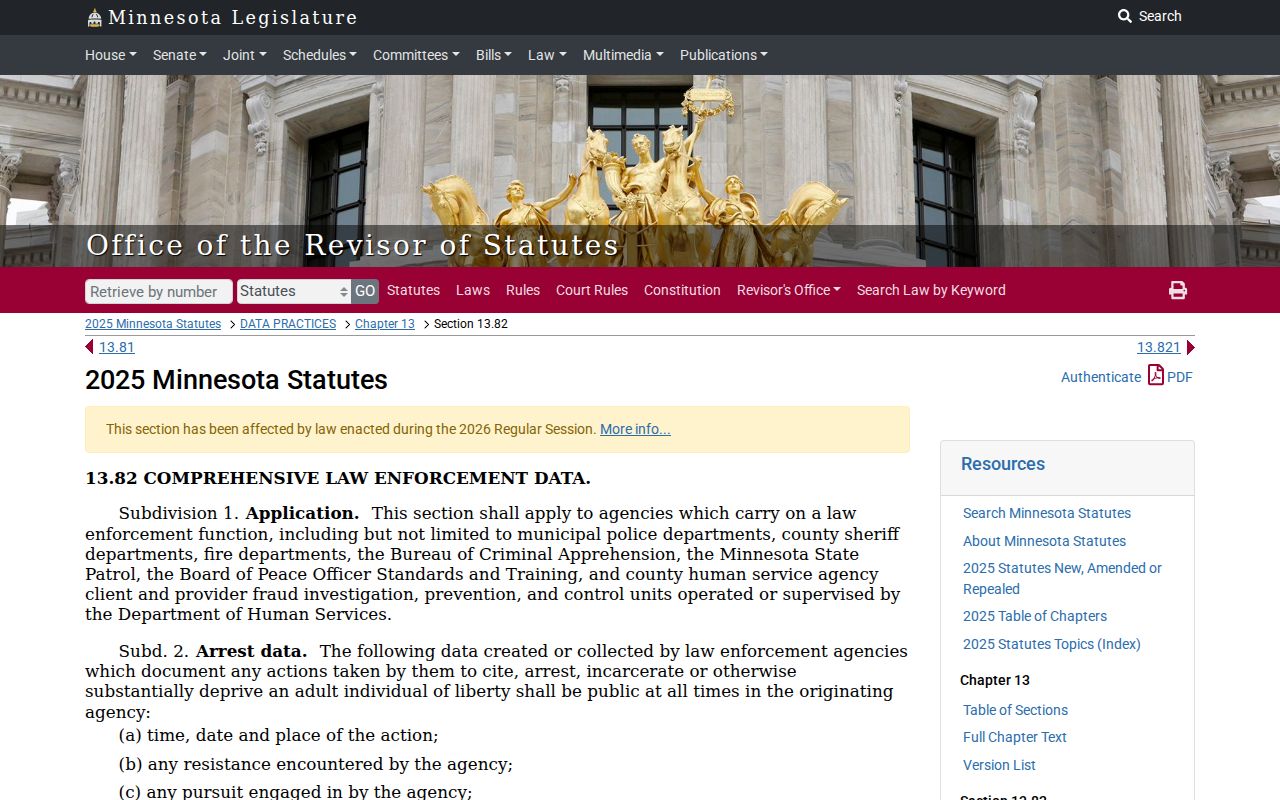
Ask the Lake County records office directly what was withheld and why, rather than guessing from a gap in the file.